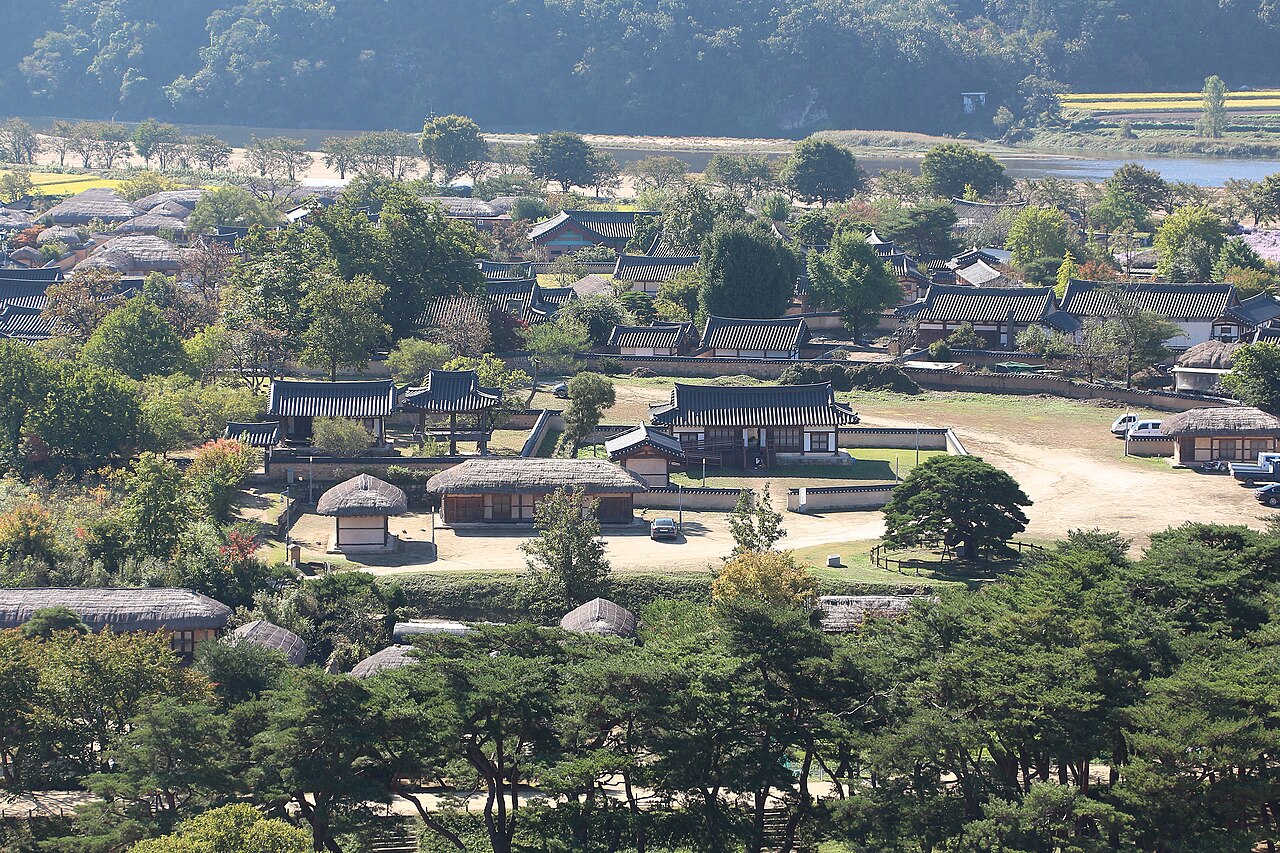
Hahoe Folk Village, Andong. Photo: Bernard Gagnon (CC0) via Wikimedia Commons
South Korea has begun installing real-time flood monitoring equipment at Hahoe Village, a UNESCO World Heritage site in Andong, as intensifying monsoon rains push the country to put technology between its cultural treasures and a changing climate.
The National Disaster Management Research Institute (NDMI), an arm of the Ministry of the Interior and Safety, announced on July 21 that it is piloting flood-measurement devices at the 600-year-old village in partnership with the National Research Institute of Cultural Heritage. The sensors will allow officials to monitor flooding conditions at the site in real time.
Notably, the equipment was designed and built in-house by NDMI’s flood prediction research team rather than purchased off the shelf. According to the institute, the custom devices cut manufacturing and installation costs significantly compared with commercial equipment while remaining simple to deploy — a model that, if the pilot succeeds, could be replicated across other heritage sites without major budgets.
The project builds on a disaster-management cooperation framework the two institutes established last year to scientifically assess flood risks to cultural heritage and prepare preemptive responses.
Why it matters
Hahoe Village — a remarkably preserved Joseon-era clan village wrapped in a bend of the Nakdong River, inscribed by UNESCO in 2010 — is defined by the very river that now threatens it. The announcement comes as heavy monsoon rains batter Korea this week, with landslide warnings raised in southern regions, and as the 48th session of the UNESCO World Heritage Committee convenes in Busan, the first ever held in Korea. Climate adaptation for heritage sites is emerging as a global agenda, and Korea is positioning itself as a test bed: low-cost, self-developed monitoring hardware applied to a living village where residents still occupy centuries-old homes.
For heritage managers elsewhere facing the same equation — rising flood risk, limited budgets, irreplaceable sites — the Andong pilot is one to watch.
Source: National Disaster Management Research Institute (Ministry of the Interior and Safety) press release (Korean), July 21, 2026, via korea.kr (KOGL Type 1). This article was produced with AI assistance and reviewed by a human editor.
작성자 소개