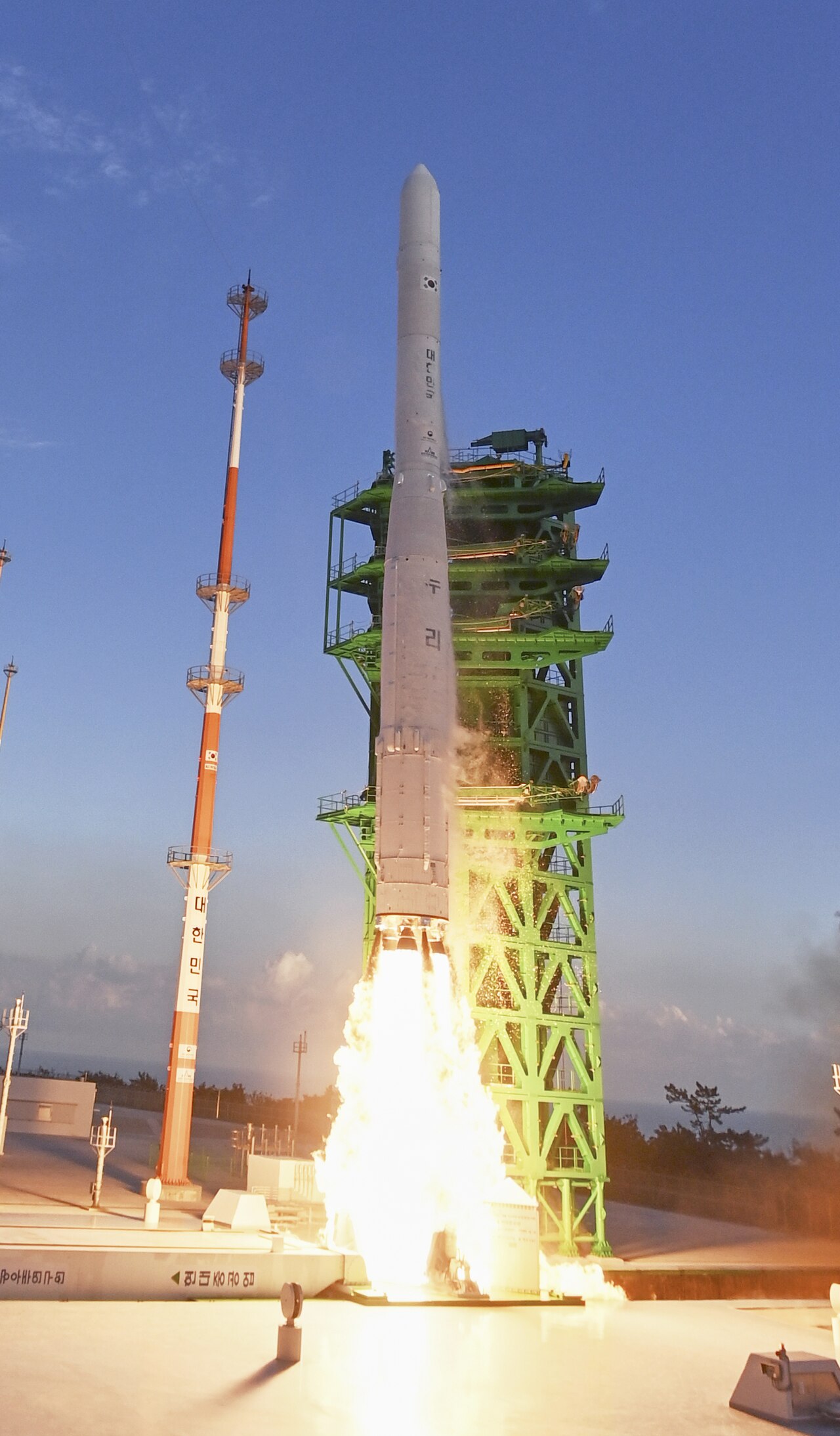
Nuri (KSLV-II) launch. Photo: Korea Aerospace Research Institute (KOGL Type 1)
South Korea has laid out its most ambitious space industrial policy to date: a national strategy targeting 3 percent of the global space and aerospace market by 2035, built around a homegrown satellite internet constellation, an accelerated Moon landing, and a southern-coast industrial belt anchored by the country’s young space agency.
The “Korea Space and Aerospace Industry Development Strategy” was approved on July 3 at the 5th National Space Committee — a presidential-level body — held at Gyeongsang National University in Jinju. It marks a deliberate pivot in the government’s role, in its own words, from “developer” to “supporter”: public demand as the anchor customer, private industry as the builder.
The headline programs
- A Korean LEO satellite communications network. A cross-ministry task force will build toward mass satellite production capability by 2030, in-orbit verification of communications satellites by 2032, and a completed network by 2035 — Korea’s answer to the strategic question posed by Starlink-style constellations, framed explicitly as a matter of national security and “communications sovereignty.”
- A faster path to the Moon. A small lunar lander developed jointly with private companies is now targeted for 2030 — pulling Korea’s first Moon landing forward — followed by a national lunar lander in 2032.
- Launch autonomy. Repeated launches of the Nuri rocket to build reliability, early reusability for the next-generation launcher, and a principle the strategy states plainly: “our satellites on our launchers.” A second spaceport site will be selected by public competition.
- Aircraft as well as spacecraft. Korea aims to join a global next-generation airliner co-development program around 2028 and begin flight tests of a hybrid electric-turbine VTOL aircraft prototype by 2030.
Geographically, the strategy concentrates the industry into a “southern coast aerospace belt”: launch infrastructure in Goheung, satellite development in Sacheon and Jinju, and aircraft manufacturing in Sacheon and Changwon, with a comprehensive “space aerospace hub” built around the Korea AeroSpace Administration (KASA) headquarters in Sacheon. KASA itself was only established in May 2024.
Why it matters
Korea is applying the playbook that built its defense export boom — government-anchored demand, concentrated industrial clusters, aggressive export orientation — to space. The overlap is not incidental: the same companies (Hanwha Systems, Hyundai Rotem, KAI) appear in both sectors, and Korean space firms have already begun marketing to Eastern European governments on the strength of K-defense credibility. For global investors and industry watchers, the strategy defines where Korean capability, procurement, and partnership opportunities will concentrate over the next decade.
Source: Korea AeroSpace Administration press release (Korean), July 3, 2026, via korea.kr (KOGL Type 1). This article was produced with AI assistance and reviewed by a human editor.
작성자 소개